Body Safety Rules: a free chart on safe and unsafe touch
This is a free Body Safety Rules chart for Class 1 to 5 in India. It gives children six rules they can say aloud, the real names for their private parts, and one number, 1098, the Child Helpline. Print the A3 poster for class and the home pages for parents.
What is in the kit
Poster, colour and black and white
The six rules and the body map, for the classroom wall.
Teacher note, two sides
The words, a 10-minute plan, and what to do if a child tells.
Lesson plan, 30 minutes
Scripts for Class 1 to 3 and Class 4 to 5.
Scenario cards
Twelve situations for the class to sort into safe, ask or tell.
Colouring sheet
The body map in outline, for children to colour at home.
Parent first talk
Words to say at home for ages 3 to 5, 6 to 8 and 9 to 12.
Pointing cards
Twelve picture cards for a child who does not speak.
Bookmark
The six rules and 1098, to keep in a school bag.
WhatsApp card
The rules on one image, for parents’ groups.
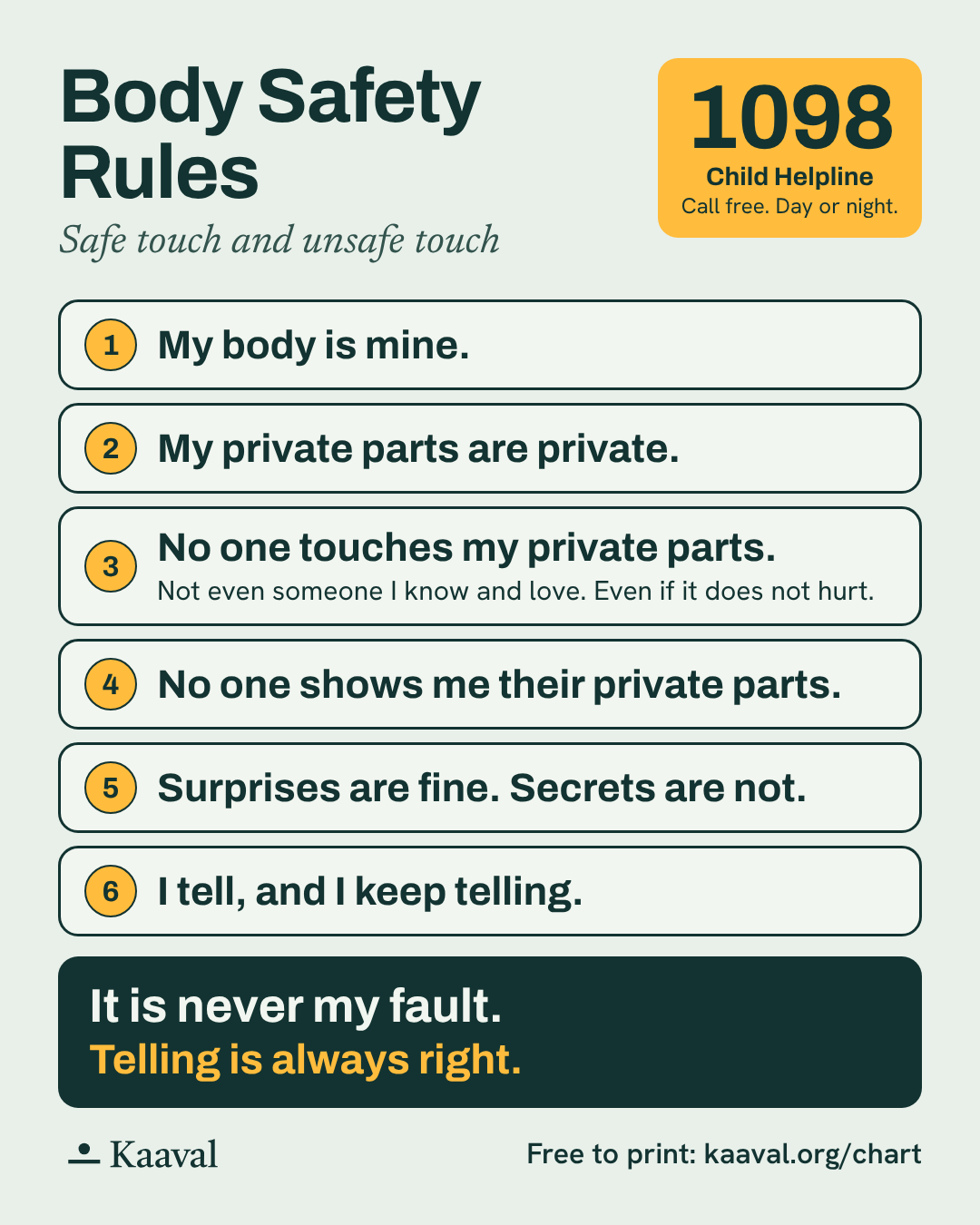
The Body Safety Rules
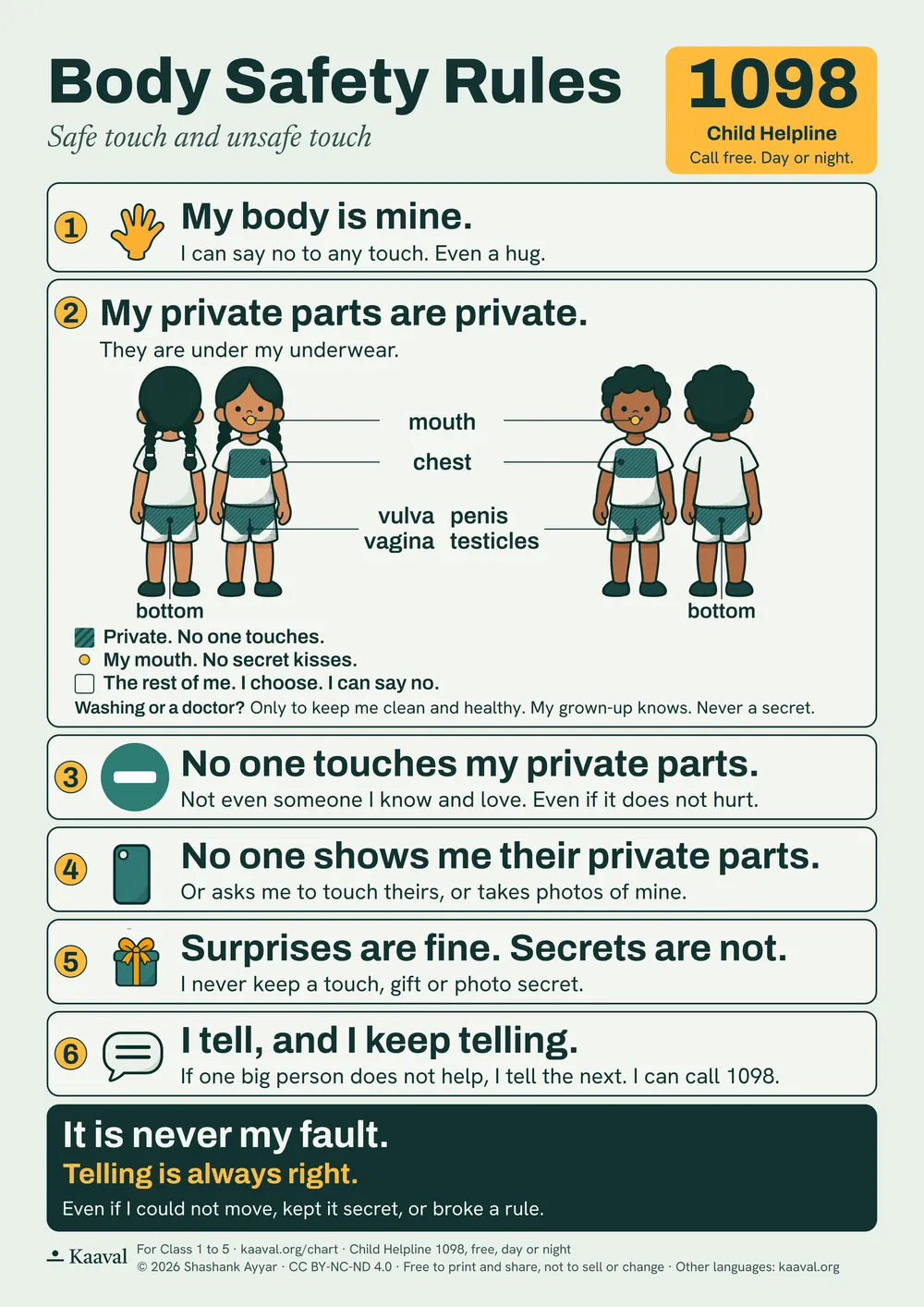
My body is mine. I can say no to any touch. Even a hug.
My private parts are private. They are under my underwear.
- Private. No one touches.
- My mouth. No secret kisses.
- The rest of me. I choose. I can say no.
Washing or a doctor? Only to keep me clean and healthy. My grown-up knows. Never a secret.
No one touches my private parts. Not even someone I know and love. Even if it does not hurt.
No one shows me their private parts. Or asks me to touch theirs, or takes photos of mine.
Surprises are fine. Secrets are not. I never keep a touch, gift or photo secret.
I tell, and I keep telling. If one big person does not help, I tell the next. I can call 1098.
1098 · Child Helpline. Call free. Day or night.
How to use it
At home
Put the poster or bookmark where your child sees it. Read one rule a day for a week. Say the real names calmly, the way you say elbow or knee. Use the parent first-talk script for your child’s age, and say often: “You will never be scolded for telling me.”
In class
Read the teacher note once before the lesson. Hold the poster up, say each map word once, and let the class say the rules back. Use the scenario cards for a longer lesson. Hang the poster at the children’s eye level, and send the colouring sheet home the same day.
If a child has told you something, read what to do first.
10 lines on safe and unsafe touch
- My body belongs to me, and I can say no to any touch, even a hug.
- My private parts are the parts under my underwear.
- Their real names are chest, vulva, vagina, penis, testicles and bottom.
- No one should touch my private parts, except to keep me clean and healthy.
- That is true even for someone I know and love, and even if it does not hurt.
- No one should ask me to touch their private parts, show me theirs or take photos of mine.
- A surprise is happy and ends soon, but I never keep a secret about a touch, gift or photo.
- Most children who are hurt are hurt by someone they already know.
- I tell a big person I trust, and if they do not help, I keep telling until someone does.
- It is never my fault, and in India any child can call 1098, free, day or night.
Why we say safe and unsafe, not good and bad
Many charts say “good touch” and “bad touch”. We say safe and unsafe. Some abuse does not hurt, and some of it can feel nice, so a child who learns that a bad touch feels bad may not tell. “Bad” can also make a child feel that they are bad. A clear rule about which parts, and what is not allowed, is easier for a young child to use. “Unsafe” keeps the blame on the person who did it.
Questions parents and teachers ask
What age should I start teaching body safety in India?
Start at about age 3, at bath time, with the real names for private parts. Add the rules about secrets and telling by age 5 or 6, when your child starts school. By 9 or 10, add phones and photos. Repeat the rules every year, because young children forget the names unless they hear them often.
What is unsafe touch?
Unsafe touch is any touch of a child’s private parts, except to keep them clean and healthy. It also includes asking a child to touch someone else’s private parts, showing them, or taking photos. In India, the law treats anyone under 18 as a child. An unsafe touch can come from someone the child knows and loves.
Why does the chart use words like penis and vulva?
Children who know the real names can tell an adult clearly what happened, and the adult understands. Words like “shame” or “su-su” make private parts sound dirty and hard to talk about. Say the names calmly at home and in school, so that every child in India has the words to tell.
What should I do if a child tells me something?
If a child in India tells you someone touched or abused them, stay calm. Tell them you believe them and that it is not their fault. Keep them away from the person they named, and do not confront that person. Then call 1098, India’s Child Helpline. If anyone is hurt or in danger now, call 112.
Will this chart keep my child safe?
No chart can do that. Studies of school body safety lessons show that children learn the words, learn the rules and are more likely to tell. In India and everywhere, keeping children safe is the job of adults. The chart helps a child know the words and know who to tell.
Can I print, share or translate the chart?
Yes, you can print and share it free, at home, in school or with any group in India. Please do not sell it or change the words, because the wording is chosen for child safety. To ask for the chart in your language, write to us through kaaval.org.
Sources
- Walsh and others, School-based education programmes for the prevention of child sexual abuse, Cochrane Review, 2015 (CD004380)
- Kenny, Wurtele and Alonso, Evaluation of a personal safety program with Latino preschoolers, 2012: the names fade without repetition
- NCRB, Crime in India 2024, Vol. 1, Table 4A.10: relation of offenders to child victims under POCSO
- POCSO Act 2012, section 2(1)(d) and section 19
- Tulir, on safe and unsafe touch, 2009
Licence
© 2026 Shashank Ayyar · CC BY-NC-ND 4.0 · Free to print and share, not to sell or change